M-Hat for Raspberry Pi
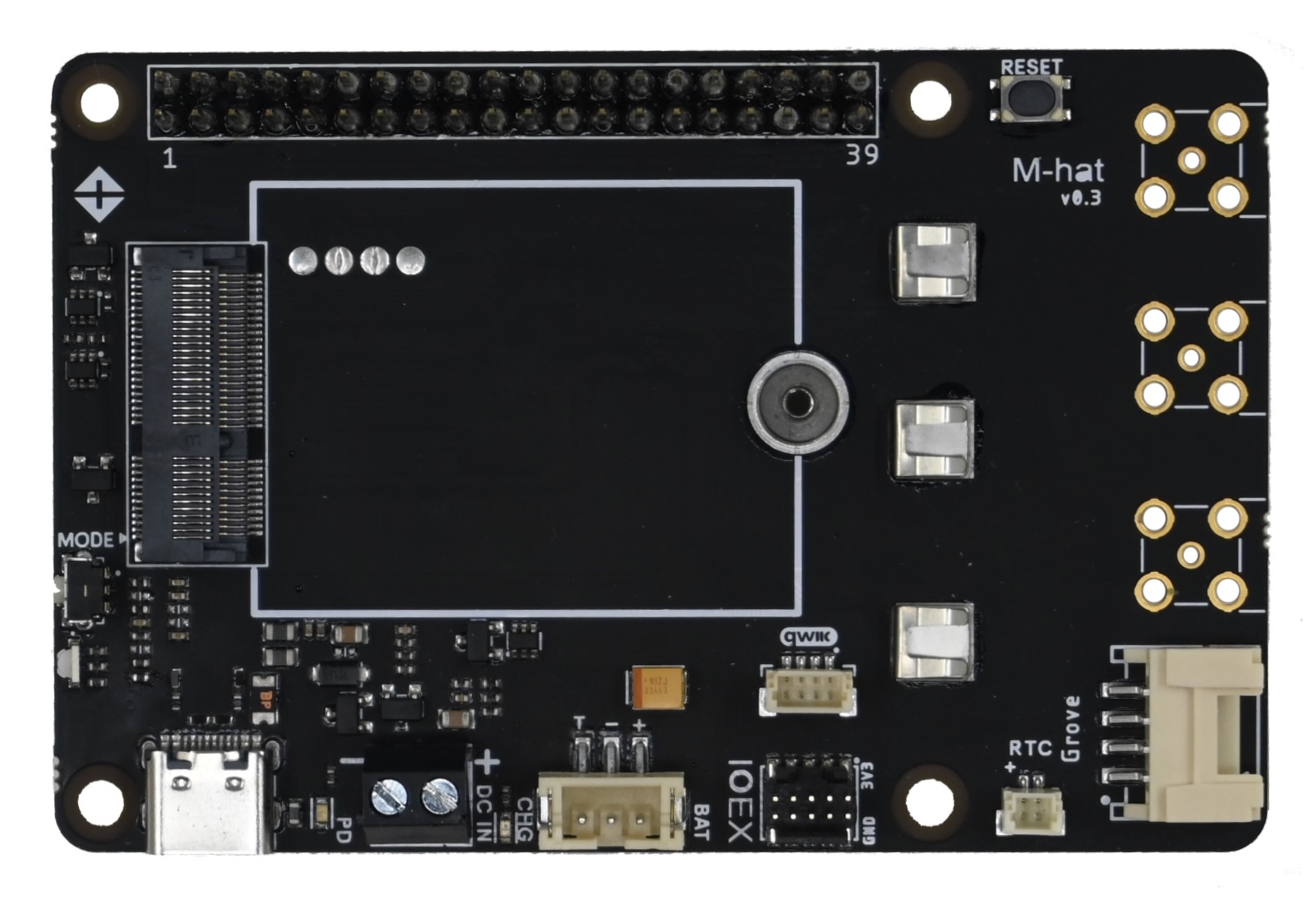
The M-Hat is a Raspberry Pi HAT (Hardware Attached on Top) that adds cellular connectivity, advanced power management, and Particle Cloud integration to any Raspberry Pi 3, 4, or 5.
The M-Hat sits on top of a Raspberry Pi, hosts a Particle M.2 cellular SoM, and shares that SoM's LTE connection with the Pi over UART tethering. It also takes over power management for the entire stack, including battery charging, power input selection, and the ability to control the Pi's power supply directly from SoM firmware.
Key Features
- Cellular connectivity: LTE via an installed Particle M.2 SoM, shared to the Raspberry Pi over UART tethering (PPP). Enables the Pi to use the SoM's cellular connection as its internet uplink. Tethering requires LTE Cat 1 - see Supported Hardware below.
- Particle Cloud integration: The SoM connects to and is managed by the Particle Cloud, enabling OTA firmware updates, event publishing, and device management.
- Advanced power management: Accepts USB-C PD, 5-12V DC, LiPo battery, or HAT 5V as power inputs. Includes a built-in battery charger rated for the Pi's peak current requirements.
- Pi power control: A dedicated PFET allows the Particle SoM to control the Raspberry Pi's power supply entirely from firmware, enabling timed power cycles and wake-on-demand operation.
- Ultra-low power sleep and wake: The entire stack (SoM + Pi) can enter a deep sleep state. A dedicated wake pin connected to the onboard AM1805 RTC enables timed or event-triggered wake-up.
- Watchdog supervision: The SoM can reset itself via the onboard watchdog without interrupting the Pi's power supply.
- HAT pass-through: A pre-soldered stackable 40-pin female header (3mm added height) passes all Pi GPIO signals through, allowing additional HATs to be stacked on top.
- Battery-powered operation: The integrated LiPo charger and boost converter allow the full Pi + M-Hat stack to run from battery.
- GNSS (SoM-dependent): GNSS capability depends on the installed SoM. An SMA connector for an external GNSS antenna is provided on the board.
- BLE (SoM-dependent): BLE capability depends on the installed SoM. An SMA connector for an external BLE antenna is provided.
- Expansion: Grove connector, 1 Qwiic connector, I/O expansion header (IOEX), three SMA connectors for external antennas.
Supported Hardware
Particle SoMs
The M-Hat accepts Particle M.2 SoMs from two families:
| Family | Status | Supported SKUs | Tethering support |
|---|---|---|---|
| M-Series | Current | M404 (LTE Cat M1/2G, North America) M524 (LTE Cat 1, EMEAA) M635 (LTE Cat M1/2G + satellite, Global) | Coming soon |
| B-Series | Legacy | B504e (LTE Cat 1, North America) B524 (LTE Cat 1, EMEAA) | Supports tethering |
Tethering requires an LTE Cat 1 cellular connection and has been tested and validated on the B504e and B524. Tethering support for M-Series SoMs is coming soon.
Raspberry Pi Models
| Model | Status |
|---|---|
| Raspberry Pi 5 | Supported, tested |
| Raspberry Pi 4 | Supported, tested |
| Raspberry Pi 3 | Supported (tethering not yet verified - see Setup guide) |
Pi boards with built-in heatsinks are supported. PoE HATs are supported when stacked below the M-Hat.
Network Requirements
Cellular connectivity type is determined entirely by the installed SoM - the M-Hat itself is a carrier board and is cellular-agnostic. LTE Cat 1 SoMs (B504e, B524) support tethering and provide higher data rates. Tethering support for M-Series SoMs is coming soon. A Particle SIM or compatible SIM is required. See the cellular carrier list for supported networks by region.
Available SKUs
| SKU | Contents | Region |
|---|---|---|
| MHATCBKIT | M-Hat board only | Global |
| MHATB504e | M-Hat board + B504e SoM | North America |
| MHATB524 | M-Hat board + B524 SoM | EMEAA |
EMEAA: Selected countries in Europe, Middle East, Africa, and Asia, including Australia and New Zealand.